Jumaat, 30 September 2011

Syarahan saya yang terakhir oleh GM Capablanca

Baru-baru ini saya telah membaca sebanyak 3 kali buku bertajuk ‘My Last Lecture’ oleh GM Jose Raul Capablanca.

Terdapat banyak isi yang saya belajar dan di sini saya akan berkongsi sebahagian pati yang saya rasakan cukup penting untuk dikongsi bersama.  Atas sebab ini jugalah kenapa saya bercadang untuk menulis tentang ending (penamat)

Dibawah adalah dalam versi bahasa inggeris, selepas ini saya akan terjemahkan setiap baris mengikut kefahaman saya

To produce such a work it is by no means necessary to be a master of the very first rank.  There are many fairly strong players who could put the chess world in their debt by writing one of these much needed book (endgame) – GM Jose Raul Capablanca

Untuk menghasilkan sesuatu kerja (endgame) tidak perlu Master kelas pertama.  Terdapat ramai pemain yang bagus boleh menyumbang sesuatu dengan menulis buku yang amat diperlukan ini (endgame)

The three essentials for a masterpiece in the field of endgame composition:

  1. Naturalness of Position
  2. Depth
  3. Beauty of Solution
Ada 3 intipadi sebuah karya agung terutama dalam endgame (penamat) iaitu 
1. Posisi yang semula jadi (kerap keluar semasa permainan dan bukan direka-reka)
2. Penyelesaian yang begitu dalam
3. Penyelesaian yang begitu indah

In order to improve your game you must study the endgame before anything else.

Anda mesti belajar endgame (penamat) sebelum belajar apa jua agar permainan anda meningkat

Almost all the books on endgames are little more than repetitious collection of various endgame positions either without notes of any kind or with very inadequate ones.

Hampir semua buku endgame (penamat) yang ada di pasaran terdiri daripada ulangan posisi yang samada tanpa nota ataupun jika ada, tidak mencukupi untuk menerangkannya

You cannot have a well-grounded understanding of the openings, nor can you satisfactorily appraise a great many of the current opening variations without an adequate knowledge of endings.

Anda tidak boleh mempunyai pemahaman opening (bukaan) yang cukup baik sekiranya tanpa pengetahuan ending (penamat) yang cukup

Ninety percent of the book variations have no great value, because either they contain mistakes or they are based on fallacious assumptions; just forget about the openings and spend all that time on the endings.  In the long run you will get much better results that way.

90%  variasi bukaan tidak mempunyai nilai yang besar, kerana samada ianya mempunyai kesilapan ataupun berdasarkan anggapan yang tidak munasabah, lupakan bukaan dan belajarlah sepanjang masa tentang penamat.  Dalam jangka masa yang panjang, anda akan mendapat keputusan yang baik dengan cara sedemikian

Rook+King vs King
2 Bishop+King vs King
Bishop+Knight vs King (most complicated)

Special case
King dan Pawn Endgame
If were to remove all the pieces, leaving only the pawns on the board...by Capa

Maroczy – Queen and  Pawn ending
Rubinstein-Tarrasch – Rook and Pawn ending

*cadangan ending (penamat) yang perlu belajar oleh Capa

Of the modern masters, only Euwe and Fine contributed to the increase of our knowledge in this important department of the game.

Master Moden, hanya Euwe dan Fine meningkatkan kefahaman kita tentang endgame (penamat)

Ulasan penulis, GM Euwe adalah lelaki yang mengalahkan GM Alekhine disebabkan pemahaman Euwe yang mendalam tentang endgame, hanya selepas Alekhine belajar mendalam tentang endgame barulah Alekhine dapat membalas dendam.  Kedua, GM Fine mempunyai rekod yang cukup baik melawan juara-juara dunia pada zaman beliau.  Ini termasuk GM Lasker dan GM Capa.  Hal ini berlaku disebabkan beliau mempunyai pemahaman endgame yang mendalam. Rekod beliau di Chessgame adalah hampir 70% dan dalam kajian menggunakan Rybka 3, Fine mendapat tempat antara yang teratas.

We really need three separate treatises: one dealing with Rook and Pawn endings, one with endings involving Queens, and one work on endgames in which a Bishop is opposed to a Knight.

Kita perlu belajar Rook dan Pawn ending, Queen ending, Bishop melawan Knight

Troitzky – These endings are of the greatest value, not only because of their beautiful variations, but because they frequently contain positions which might easily arise in over-the-board play.

Cadangan Capa untuk membaca buku karangan Troitzky disebabkan IA MUDAH UNTUK TERHASIL semasa bermain catur, bukan direka-reka
 
I have often been asked by amateurs whether problem-solving is beneficial.  It is true that solving problems stimulates one’imagination, but the fact that the original positions of these problems are almost always artificial is a grave drawback.  But with these endings you not only exercise your imagination; you deal with the same conditions that apply in actual play

Cadangan Capa kepada pemain amatur berkenaan menyelesaikan 'tactical puzzle'.  Hakikatnya puzzle sedemikian amat jarang terhasil semasa bermain catur.  Inilah kelemahan tactical puzzle.  Tetapi dengan belajar ending, anda bukan saja melatih imaginasi anda, malahan kekerapan ianya keluar dalam permainan sebenar menyebabkan ianya cukup penting.


Sekian terima kasih

Permainan Gajah AKA Xiangqi

Baru-baru ini, seorang blogger tempatan ada menulis tentang Soal Jawab bersama GM Alexander Morozevich
"About training Zhu Chen, he said: "The most interesting thing is that she's Chinese. She has a totally different understanding of everything. I was learning the way Chinese people are understanding chess."

Terjemahan
'Tentang melatih Zhu Chen, dia berkata 'Yang paling menarik adalah dia seorang cina.  Dia mempunyai kefahaman yang berlainan tentang kesemua benda.  Saya telah belajar cara orang-orang cina memahami permainan catur'

lantaran itu, saya telah belajar Xiangqi (sudah sebulan) dengan download program percuma dengan menaip Xiangqi di wikipedia.

Selepas bermain Xiangqi, kefahaman saya tentang catur (Chess) bertambah secara mendadak.

Dengan bermain Xiangqi, saya telah belajar banyak benda, antaranya adalah:
1. Petak lemah (Weak Square).  Dalam chess, ada istilah yang sama, seperti contoh kalau Bishop petak hitam telah mati, ini membawa maksud, petak hitam keseluruhannya adalah lemah, ini boleh digunakan dengan sebaik-baiknya.  Tetapi di Xiangqi, ini menentukan menang dan kalah sesuatu permainan.  Kuasanya umpama menguasai fail dengan 2 Rook connected (bersambung).  Selama ini saya anggap hal sedemikian 'perkara kecil', hakikatnya cukup besar!.

2. Dalam buku karangan GM Kotov - How to think like Grandmaster.  Ada 1 game yang dianalisa oleh GM Botvinnik (Botvinnik vs Stahlberg Moscow 1935).

Botvinnik vs Stahlberg

GM Botvinnik menyatakan, 'beliau menang game ini disebabkan kedua-dua kuda musuh yang saling bertahan antara satu sama lain adalah penyebab beliau menang sebab kedua-dua kuda ini adalah hanging (tergantung)'.  Hal yang sama berlaku, saya menganggap hal sedemikian sebagai 'perkara kecil', hakikatnya ia menentukan menang kalah terutama semasa bermain Xiangqi.

3. Xiangqi mengajar kita tentang pentingnya endgame (penamat).  Hal yang kebanyakan pemain amatur anggap tidak penting.  Kebanyakkan pemain amatur mementingkan opening (bukaan).  Ternyata ini adalah salah seperti yang dinasihatkan oleh GM Capablanca.  Mula-mula sekali anda perlu berlain Endgame (Penamat) untuk bermain dengan baik.

4. Koordinasi buah catur yang harmoni.  Kadang-kadang kita hanya menghantar kuda-kuda kita menyerang tanpa bantuan buah-buah lain seperti bishop dan queen.  Perlu meletak mereka pada petak yang sesuai, di petak musuh yang paling lemah dan sebagainya.  Hal ini hanya lebih jelas selepas saya belajar bermain Xiangqi dan melawan pemain Xiangqi yang pada hemat saya 'kuat'.

Hanya selepas saya bermain Xiangqi, kemudian saya bertukar ke catur biasa, permainan catur saya menjadi semakin laju, saya boleh lihat betapa koordinasi buah catur musuh yang lemah, dan saya cuba untuk mengambil kesempatan atas kelemahan itu.

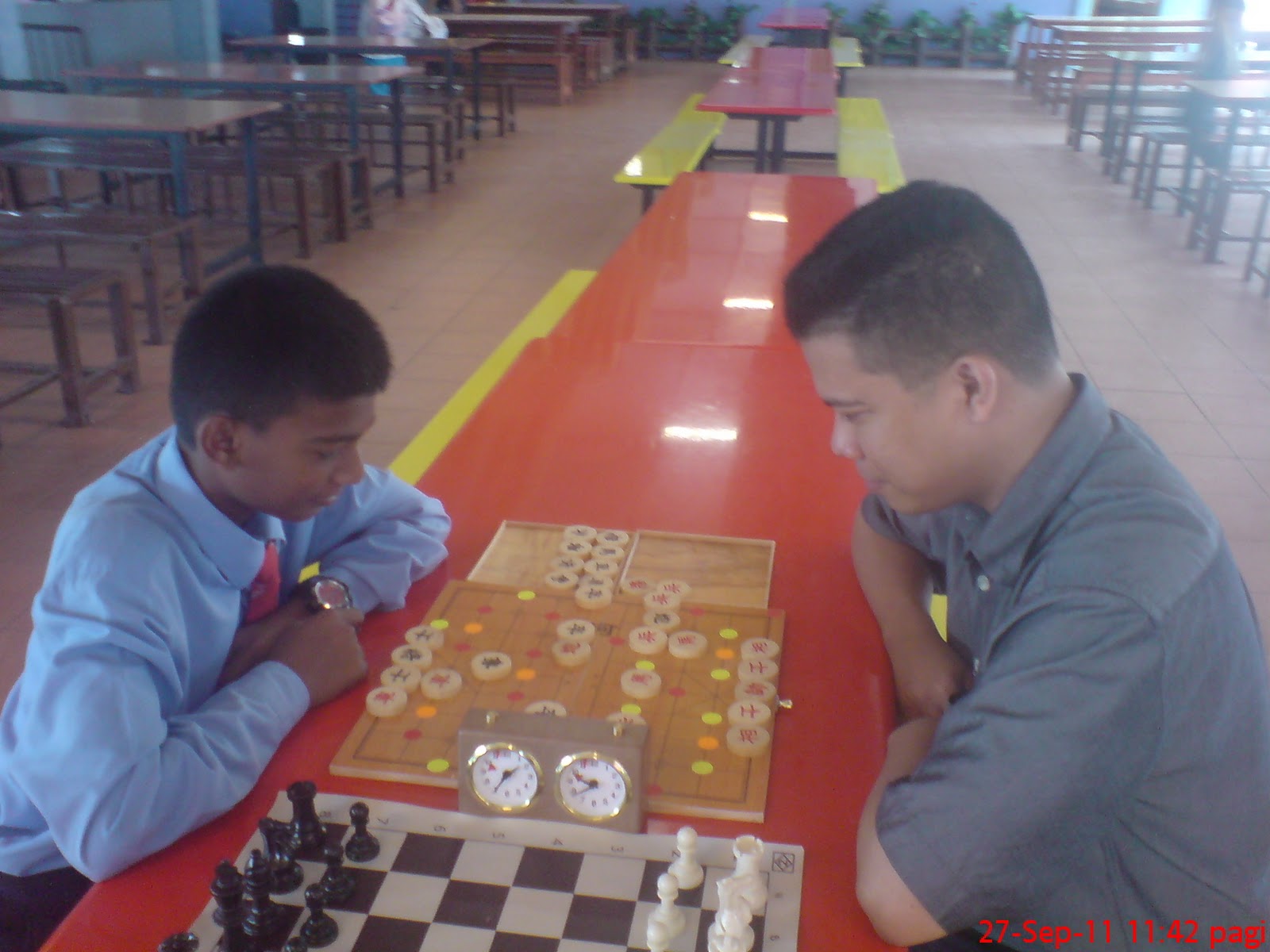
Yang paling indah adalah, saya berjaya mengajar seorang pelajar berbangsa india untuk belajar bermain xiangqi.  Nanti saya post gambar tersebut, seorang lelaki muslim yang berasal daripada sabah bermain xiangqi kepada seorang pelajar india.  Gambar 1 Malaysia saya!


Isnin, 19 September 2011

1 Permulaan

Assalamualaikum dan Salam Sejahtera
Kesemua buku catur yang saya baca adalah dalam Bahasa Inggeris.  Sebahagian daripada rakan-rakan saya mencadangkan saya untuk menulis buku catur dalam Bahasa Melayu (pada hemat mereka saya bermain dengan cukup baik walhal kekuatan saya hanyalah rating 1500).  Mereka katakan ianya pasti akan dibeli oleh ramai orang, sebab ramai yang minat catur tetapi malangnya tidak membaca buku catur disebabkan rata-rata dalam Bahasa Inggeris.

Atas kesedaran itu, sebagai permulaan, saya bercadang untuk berjinak-jinak membuat blog, semata-mata mengasah bakat penulisan saya.  Sebarang cadangan amat dialu-alukan.

Secara kasar Blog ini akan menceritakan, membincangkan tentang Catur dalam Bahasa Melayu.  Mungkin posting permulaan  saya ada banyak Bahasa Inggeris didedikasikan semata-mata untuk Hero saya iaitu GM Leonid Stein.

Dari segi Opening (Bukaan), Middlegame (Pertengahan permainan), Endgame (Penamat), Tokoh-Tokoh, Psikologi, Kajian dan Pemerhatian saya tentang Catur Di Dunia Amnya, Di Malaysia Khususnya.

Sekian Terima Kasih
Selamat Bermain Catur

Isnin, 30 November 2009

Quote about Leonid Stein

sebahagian quote tentang hero saya...GM Leonid Stein....nanti saya akan tambah lagi di lain masa


"they can refute it during post mortem analysis, but never in a game"
- GM Leonid Stein

Viktor Korchnoi after a world championship game of his:
"Karpov read somewhere that Bishop is stronger than a Knight; in Leonid Stein's hands, not his!"

Quote: “To play for a win in Black against Polugaevsky was an ungrateful task. Many expected that the game would end up in a quiet draw; that Stein would not risk and would try to make up for the difference in points against less formidable rivals… The course of this game, in its own way, illustrated Emanuel Lasker’s well known thought on the healthy force that was ready to take an extreme risk for the sake of achieving its goal.”


Leonid Stein vs Vasily Smyslov (1972) "The Pin is Mightier"
 Smyslov, a master of quiet positional play, has few answers for Stein's tactics.

"He was one of few players who had an even score against Vassily Smyslov, Tigran Petrosian, and Mikhail Botvinnik. He even had plus records against Mikhail Tal, Boris Spassky, and Paul Keres. Stein defeated virtually all of the top players of his era."

Leonid Stein was something of a mystery to me. He died before I learned to play chess, and, perhaps because he was never world champion, I am not very familiar with his games. Crouch spends several pages discussing the man himself and shows some interesting statistics. Stein had very respectable scores against the top players of his era, to say the least. He was a great attacking player, but, as Crouch puts it, “Stein takes calculated risks, and in every game he calculates not only whether he should attack and takes risks, but also whether it is time not to take risks.”

In this position Stein had managed to trick a young Karpov into playing a Grünfeld, not exactly an opening Karpov is known to play from the black side. Black had just answered 15 f4 with 15...h6.

Crouch writes, “If Stein’s last move was highly characteristic of his own attacking play, then this in return is typically Karpovian. Black is not indulging in complicated manoeuvring. He is pushing away one of White’s most dangerous pieces, and saying ‘I don’t believe your sacrifice, I’m not going to lose, and I could well win’.

“Such coolness of response is rare. Most of us, when we see a sacrificial attack by the opponent, see the king being pushed into the open, tend to get anxious, maybe even panicky. Quite often this is of great help to the attacker. If the critical defensive line is avoided, then there will be no refutation, and the element of the bluff will turn into a smooth attacking win. An excellent example involving two former World Champions is the game Spassky-Tai in Montreal 1979, where Spassky fell for the bluff. Here Karpov stayed in full control.

“Now for the critical position. There is not much point in withdrawing the knight, 16 e4? cxd4 17 cxd4? Bxe4 being an outright blunder, so White must sacrifice. Obviously Stein has already decided on the knight sacrifice, but which one?”

Stein played 16.Nxe6 and won. After annotating the game, Crouch returns to the position and spends a lot of time on the alternative 16.Nxf7. I like this approach, because it allows the reader to enjoy the game without much distraction, and then review the critical point in the game in an analysis session.

While Tal is the more popular and famous player compared to Stein (for obvious reasons), I have never fully embraced the kind of swashbuckling risk-taking that is more prevalent in the games of players like Tal. The chapter on Tal is also instructive, but for me personally it was less fun to go through. Despite Tal’s popularity and obvious objective strength, his games, despite their attractiveness, never really “spoke” to me. There is too much randomness in the games; too much “bluff.”

In the introduction Crouch emphasizes “that it is best, if possible, to play positionally” and that it is only in a minority of games that sacrificial play is effective. He notes that “good and creative positional chess” can give one the opportunity to take advantage of an opponent’s mistake and that the golden rule is “a player cannot lose a game unless there is a mistake.” He points out that although nearly every game in the book is a win, the notes reveal that with precise play the outcome should have been a draw or an advantage for the defender. Thus, “it is genuinely positionally acceptable to aim for a win and to create pressure. If in your attack you do  not make a mistake, you will not lose.”

However, he also notes that if “a player attacks with extreme accuracy, then the defender has no chances of a win,” or that any inaccuracy by the defender will result in a loss. Therefore, the games in this collection tend to be “highly complicated, probably much more so than in strategic or positional duels” and that “thorough analysis is required.” His goal is that the reader is entertained and informed along the way, and rest assured it is both.

By IM Colin Crouch